ARTICLE
Microwaves Australia (2026): Inverter, Flatbed and Convection Models Compared
Published Jun 3, 2026 • Updated Oct 8, 2026 - 4 min read
This guide compares the top picks across inverter, flatbed and convection models to help you find the right fit for your kitchen and budget.
Key takeaways from this article
Inverter microwaves are worth the extra cost for daily use, especially for defrosting.
Flatbed models are easier to clean and fit larger dishes than turntable designs.
Convection microwaves can bake and roast, making them useful as a second oven.
Built-in models suit renovations with the right cabinetry, ventilation and installation budget.
For one to two people, 17 to 20 litres is enough; families of four need 25 to 30 litres.

The choice is more involved than it might appear on the shelf. Inverter versus standard magnetron, flatbed versus turntable, microwave only versus convection combination, countertop versus built-in - and then there is capacity, wattage, and what you are actually going to cook. Each decision changes the result.
This article covers the best microwave options for different kitchens and households, then steps through the key technology questions so you can make a confident call. If you want a deeper look at specs and features, The Good Guys' Microwave Buying Guide covers all the details.
Microwaves worth buying for every kitchen and budget
Rather than ranking models 1 to 10, the picks below match the best microwave to each specific situation. Check current pricing and availability on The Good Guys' microwave range before publishing - prices are indicative and should be confirmed against the live listing.
Best overall microwave
For a typical Australian household, an inverter microwave in the 25 to 34 litre range offers a practical balance of even heating, usable capacity and everyday ease of use. Inverter technology handles defrosting and low-power cooking reliably, and this size fits a dinner plate or a family casserole dish without taking over the bench. Panasonic, Sharp, LG and Hisense all offer well-specified options at this size.


Best compact microwave for small kitchens
If bench space is the main constraint, a 20 litre benchtop microwave handles reheating and basic cooking without dominating the kitchen. It's ideal for a single person, a couple or a second kitchen. Sharp, Hisense, Solt and Panasonic all make compact models in this size.


Best inverter microwave
An inverter microwave delivers continuous power at the selected level rather than cycling on and off. That gives more even results when defrosting, simmering or reheating delicate foods. Larger inverter models in the 34 to 44 litre range with 1100 to 1200W of power suit bigger households and larger dishes. Sharp, LG, Hisense and Panasonic all offer options in this space.


Best microwave under $200
Entry-level models from LG, Westinghouse and Sharp cover the basics at a budget price. Expect 20 to 25 litres and 750 to 1000W, which is enough for reheating, defrosting and simple cooking.


Best flatbed microwave
Flatbed microwaves replace the rotating glass turntable with a flat floor and a rotating antenna underneath that spreads microwave energy across the cavity. The result is a full, flat, wipe-clean floor with no plate to remove, no spindle to clean around, and no risk of dishes catching on the sides. Panasonic, Sharp and Hisense offer flatbed models from around 27 to 32 litres and 1000 to 1200W, a format that suits everyday family use. Browse flatbed microwaves at The Good Guys for current models and pricing.


Best convection microwave
A convection microwave adds a fan-forced heating element to the standard microwave, so it can bake, roast and brown in a way a microwave-only model can't. Panasonic, Sharp and Breville all offer combination models, and many now include an air fry function as well. Look for a model with microwave-only, convection-only and combined modes. The combined mode is what allows browning and fast cooking at the same time. These models cost more, and they're worth the investment if you regularly bake or roast or want a second oven.


Best built-in microwave
Built-in microwaves sit flush inside cabinetry, usually with a trim kit that closes the gap around the appliance for a neat finish. Smeg, Omega, Westinghouse and Electrolux all offer built-in options. Capacity is typically 25 to 28 litres, and controls tend to be more refined. The costs to factor in are the appliance itself, a compatible trim kit, ventilation clearance within the cabinetry and professional installation. Browse built-in microwaves at The Good Guys for current models and trim kit compatibility.


Inverter microwave vs standard microwave: which is better?
A standard microwave has one power setting: full. To simulate lower levels, it cycles the magnetron on and off in pulses - on at 100% for a few seconds, off, on again.
An inverter microwave delivers continuous power at the level you select. At 50% power, it runs at 50% consistently. That makes a meaningful difference for defrosting, reheating delicate leftovers, and long, low-power cooking like softening onions or heating custard.
Verdict: for most households who use the microwave daily, an inverter microwave is worth the extra cost. The performance gap is most obvious on defrost and low-power settings. If you mostly reheat drinks and the occasional leftover, a standard model does the job.
Flatbed microwave vs turntable microwave: which is better?
Turntable microwaves rotate the dish on a glass plate to move food through the microwave field and even out heating. The mechanism works, but the plate is more difficult to clean.
Flatbed microwaves distribute microwave energy using a rotating antenna beneath a flat ceramic floor. There is no plate to remove, no spindle, and the full cavity width is usable for any shape of dish. Cleaning is significantly faster - wipe the flat floor and the walls, and you are done.
Verdict: flatbed is the better design. Easier to clean, more flexible with dish sizes, and no mechanical plate to eventually crack or break. However, flatbed models sit higher in most ranges.
Countertop vs built-in microwave: which should you choose?
Countertop microwaves are the practical choice for most homes. Lower cost, straightforward to set up, and easy to relocate if you move. The downside is bench space - a standard microwave takes up a meaningful footprint in a kitchen where every centimetre counts.
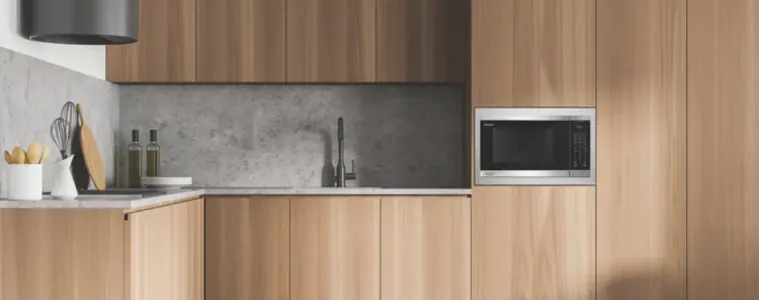
Built-in microwaves sit inside cabinetry with a trim kit that finishes the edges flush. No bench space used, and the aesthetic is clean. What built-in requires: a dedicated cavity in the cabinetry, a compatible trim kit (usually brand-specific), and adequate ventilation - built-in microwaves must have sufficient airflow around the unit or they will overheat and fail prematurely. Professional installation is strongly recommended.
Verdict: countertop for most homes. Built-in is a renovation decision - worth it if you are fitting out a new kitchen with the right cabinetry and budget for professional installation. Browse built-in microwaves at The Good Guys for current models and trim kit details.
For more detail on what to look for when buying a microwave - including sensor cooking, child locks, pre-set programs and cavity dimensions - see The Good Guys' Microwave Buying Guide.
Frequently asked questions
What is the most reliable microwave brand in Australia?
Panasonic is widely regarded as the most reliable microwave brand in Australia, particularly its inverter range. LG and Samsung are also strong options. For built-in models, Smeg, Westinghouse and Omega are the standout picks.
What is an inverter microwave?
An inverter microwave uses variable power output to heat food continuously at the selected power level. Unlike a standard microwave that cycles on and off at full power to simulate lower settings, inverter technology delivers even, consistent heat.
What is a flatbed microwave?
A flatbed microwave has no rotating turntable plate. Instead, a rotating antenna beneath the flat ceramic floor distributes microwave energy across the cavity. The flat floor is easier to clean, accommodates larger and oddly shaped dishes, and removes the risk of a dish catching on the plate edge.
What size microwave do I need?
For one to two people, 17 to 20 litres is generally sufficient. For three to four people, 25 to 30 litres covers most everyday needs. For five or more people, or if you regularly cook large dishes or bulky items, look at 30 litres or above. A standard dinner plate (26 to 28 cm) fits comfortably in a 25 litre or larger model - check the cavity width if this matters to you.
What wattage microwave should I buy?
900W to 1000W is the sweet spot for most households - fast enough for everyday cooking and capable enough at lower power settings. 700W models are noticeably slower on denser foods and less effective at even heating. 1100W to 1200W models heat fastest and give the most control, particularly useful when paired with inverter technology.
What is the difference between a convection microwave and a combination microwave?
A convection microwave adds a fan-forced heating element that allows it to bake and roast like a small oven. A combination microwave uses microwave energy and convection heat simultaneously for faster, browning-capable cooking. Both terms are often used interchangeably in product listings - check whether the model supports simultaneous microwave and convection operation if that function matters to you.
Are built-in microwaves a good idea?
Yes, if you are renovating and want a cleaner kitchen aesthetic. Built-in microwaves free up bench space and sit neatly in cabinetry. The key requirements are adequate ventilation, a purpose-built trim kit, and professional installation.
Looking for the best microwave for your kitchen, you'll find it at The Good Guys.