loading
loadingloading

Press Esc to close the search results, the Up and Down arrow keys to navigate the results, and Enter to select a result.

Participating Credit Cards. 50 Months Interest Free.
No Interest. No Deposit. Monthly payments required.


4.7 out of 5 stars from 31 reviews
97% of users recommend this product
This heater is small in size which it was I wanted but powerful enough to heat the top Quickly. I wanted a gas heater with no obvious flame as I have young children . I also wanted a timer . This heater is very efficient.
Rosa. Moore
Confirmed purchase 17 June 2025
Published on 9 July 2025
Yes, I recommend this product.
This customer is a verified purchaser who may have received an incentive in return for providing an authentic review.
The thermostat The look
Ann Bursell
Confirmed purchase 10 June 2025
Published on 3 July 2025
Yes, I recommend this product.
This customer is a verified purchaser who may have received an incentive in return for providing an authentic review.
Great smaller space heater with the benefits of a remote control.
Phil
Confirmed purchase 19 September 2023
Published on 4 October 2023
Yes, I recommend this product.
This customer is a verified purchaser who may have received an incentive in return for providing an authentic review.
All good
Peter
Confirmed purchase 26 June 2023
Published on 24 September 2023
Yes, I recommend this product.
Check out what this reviewer thought after the first 3-6 months.
My parents have the same heater which I grew up with. Since moving into my own place Ive used a recirc aircon for heat but it just isnt the same. Nothing compares to the rianni gas heater, its the best and worth the money.
Lara
Confirmed purchase 23 June 2023
Published on 7 July 2023
Yes, I recommend this product.
This customer is a verified purchaser who may have received an incentive in return for providing an authentic review.
Works great really quiet and safe around kids and pets as the outside doesn't get hot I'd get the 25 if you had open plan living
Dan
Confirmed purchase 15 June 2023
Published on 29 June 2023
Yes, I recommend this product.
This customer is a verified purchaser who may have received an incentive in return for providing an authentic review.
Only had the Gas fitter fit the bayonet connection for the heater. So first day of operation. So far so good. If today is anything to judge by, I am on a winner.
Bruab
Confirmed purchase 8 June 2023
Published on 24 June 2023
Yes, I recommend this product.
This customer is a verified purchaser who may have received an incentive in return for providing an authentic review.
Fantastic. Quiet. Effective. Love it, Thankyou.
Kelly O
Confirmed purchase 22 May 2023
Published on 5 June 2023
Yes, I recommend this product.
This customer is a verified purchaser who may have received an incentive in return for providing an authentic review.
Efficiency is very surprising, really happy with the product
Gary
Confirmed purchase 7 May 2023
Published on 21 May 2023
Yes, I recommend this product.
This customer is a verified purchaser who may have received an incentive in return for providing an authentic review.
Easily heats up small to medium rooms without any problem .. in fact will even do a larger room as heat gets around pretty quick. For my smallish office space it only needs to be on L the lowest temp setting and it heats it up rather quick. The remote is extremely handy and I have never had to touch the heater at all. Cannot go wrong with Rinnai as long as you service it once every 2 years or so. Brilliant gas heater!!
Arvind
Confirmed purchase 15 September 2022
Published on 29 September 2022
Yes, I recommend this product.
This customer is a verified purchaser who may have received an incentive in return for providing an authentic review.
You've viewed 10 of 31 reviews
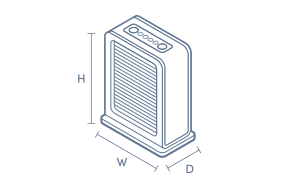
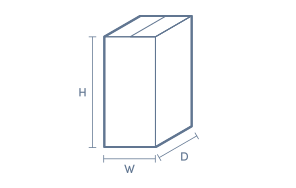
The below information is AI generated based on Australian websites information around this item. We have done our best to ensure its accuracy but suggest verifying any information within this tab before purchasing.
The Rinnai Dynamo 15MJ NG is a portable natural gas heater designed for medium to larger open-plan living areas that need fast, flexible warmth without fixed installation. It suits households wanting thermostat control, programmable timers and child-lock peace of mind. Its 5.8-star energy rating is a strong advantage, but as an unflued heater it needs permanent ventilation and is not suitable for bedrooms.
This unflued model must be used in rooms with permanent ventilation, so it is less suitable than flued or specialist bedroom-safe heaters for sealed spaces or overnight bedroom use.
Medium to larger living areas; up to 38 m² in cold conditions, 52 m² in cool conditions, and 59 m² in mild conditions
8/10 - 5.8-star energy rating gives it strong efficiency for a portable gas heater
6/10 - child lock and thermostatic control help, but unflued operation means permanent ventilation is essential and it is not suitable for bedrooms
8/10 - portable format makes it easy to reposition around the home, provided a suitable natural gas connection is available
8/10 - typically quieter than fan-forced heaters because it does not rely on strong fan noise for warmth delivery
A: Yes. This DY15SN model is a natural gas unflued heater, so it needs a compatible indoor natural gas bayonet point to run. It is not designed to connect to LPG bottles, so fuel type matters before buying.
A: An unflued heater releases warmth straight into the room instead of venting through a flue, which helps it heat quickly. The trade-off is that the room must have permanent ventilation, and some moisture can build up during use.
A: No. This style of unflued natural gas heater is better suited to living areas with permanent airflow rather than bedrooms, bathrooms, or tightly sealed small rooms. Ventilation is a key part of safe day-to-day operation.
A: Yes, 15MJ/h is generally aimed at medium to larger living spaces rather than a small study or bedroom. Actual comfort still depends on ceiling height, insulation, window area and draughts, especially in open-plan rooms.
A: It can. Unflued gas heating can add water vapour to the air, so condensation is more likely in cooler rooms or homes with limited airflow. Keeping the recommended ventilation open helps reduce moisture build-up while heating.
¤Discounts apply to previous ticketed/advertised price prior to the discount offer. As we negotiate, products will likely have been sold below ticketed/advertised price prior to the discount offer.
▽The Good Guys acts as agent for the supplier of this product. Refer to Agency supplier’s T&Cs available on supplier’s website. Discounts apply to Agency supplier’s list price of the relevant product.
>Qualifying conditions, including signing up to 90 Day StoreCash, activating a Digital Wallet before being eligible to earn/win and where a qualifying purchase is required, delivery/collection of product within 60 days. 90 Day StoreCash expires 90 days after issue. Personal purchases only. Exclusions and purchase limits apply. Each 90 Day StoreCash reward must be used in one transaction and no change/credit for any unused balance. Refer to 90 Day StoreCash T&Cs for details, including how to receive 90 Day StoreCash deposit notifications, how to earn & timing for issue of 90 Day StoreCash.